

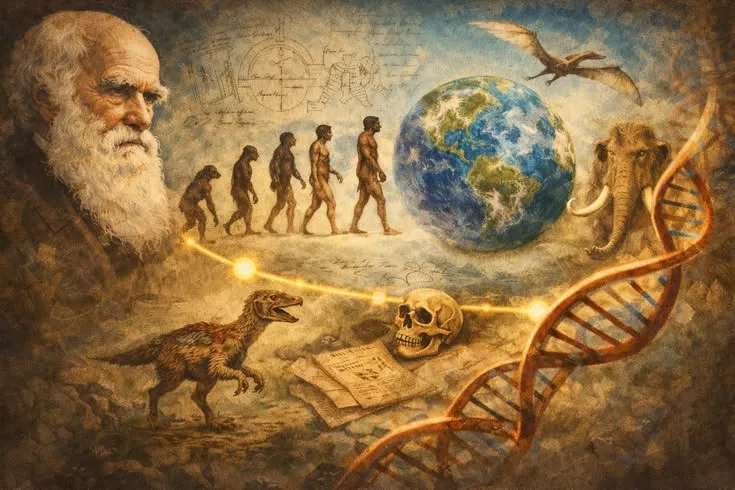
People often ask where a community came from as though there should be one simple answer. In reality, population history can include many layers: ancient settlement, migration, intermarriage, language change, political borders, religion, trade, and later diaspora. Genetic ancestry can reveal part of that history, while language and cultural identity reveal other parts. Understanding the difference is essential when exploring how communities formed and changed over time.
Language Families Record Historical Relationships
Studying language families and human migration can reveal patterns that are difficult to see through archaeology alone. Languages that share systematic similarities may descend from an earlier common language, even when their modern speakers live far apart.
Researchers compare vocabulary, sound changes, grammar, and historical records to reconstruct relationships between languages. But language is not a genetic marker. People can adopt a new language without large-scale biological replacement.
Migration Does Not Always Mean Replacement
A moving population may settle among people who already live in a region. The result can be admixture, coexistence, cultural exchange, or gradual language shift. In other cases, population turnover may be more substantial.
Ancient DNA can sometimes show a major change in ancestry while archaeology shows continuity in local traditions. The reverse can also happen: material culture may change quickly even when much of the local population remains.
Ethnic Identity Has a History Too
A tool designed to trace ancestry by ethnic group is most useful when it is understood as a guide to population history rather than a personal DNA result. Ethnic groups are social and historical communities, not genetically uniform categories.
Members of the same ethnicity can have different family histories and different proportions of ancestry from earlier populations. Boundaries between communities can also change over centuries as people migrate, marry, convert, change language, or become part of new political systems.
Names Can Hide Complex Population Stories
Modern labels sometimes make old histories look simpler than they were. A nationality may be only a few centuries old, while the region itself has been inhabited for thousands of years. An ethnic name used today may also have changed meaning across different historical periods.
Researchers therefore need to distinguish between a present-day identity and the ancient populations that lived in the same area. Geographic continuity does not automatically prove direct biological or cultural continuity.
Genetics Can Reveal Connections, Not Culture by Itself
Genetic studies are powerful for identifying biological relationships, population splits, and admixture. Ancient DNA can sometimes show that people buried in two regions were closely related or that a major new ancestry component appeared after a migration.
What genetics cannot do by itself is identify a person’s language, beliefs, social role, or ethnic self-understanding. Those questions require other evidence such as archaeology, texts, inscriptions, oral traditions, and historical context.
Treating DNA as a complete description of identity reduces a complex human history to biology alone.
Linguistic and Genetic Patterns May Overlap
Sometimes language expansion and population movement appear to line up. A migrating community may bring both its ancestry and its language into a new region. Over generations, however, the two patterns can separate.
A language can survive after major genetic mixing, or a population can retain much of its ancestry while adopting the language of another group. Political power, trade networks, schooling, religion, and prestige can all influence language change.
This is why researchers compare linguistic and genetic evidence rather than assuming one automatically confirms the other.
Individual Family History Is More Specific
Population history describes broad patterns across communities. A family history is much narrower. Two people who identify with the same ethnicity or nationality may have different recent ancestors, migration experiences, and family stories.
Genealogical records, family documents, oral histories, and personal DNA testing can sometimes add detail at the individual level, but even these sources need interpretation. Population-level summaries should not be treated as predictions about one person.
Conclusion
Language, ancestry, and identity overlap, but they answer different questions. Language families can help researchers reconstruct relationships between speech communities. Genetics can reveal biological connections and admixture. Archaeology and history provide evidence about settlement, culture, institutions, and daily life. Identity adds another layer shaped by community, memory, and social experience.
The strongest account of a population brings these strands together without treating any one of them as the whole story. Human communities are products of movement, contact, continuity, and change, and their histories are usually more layered than a single label can capture.